
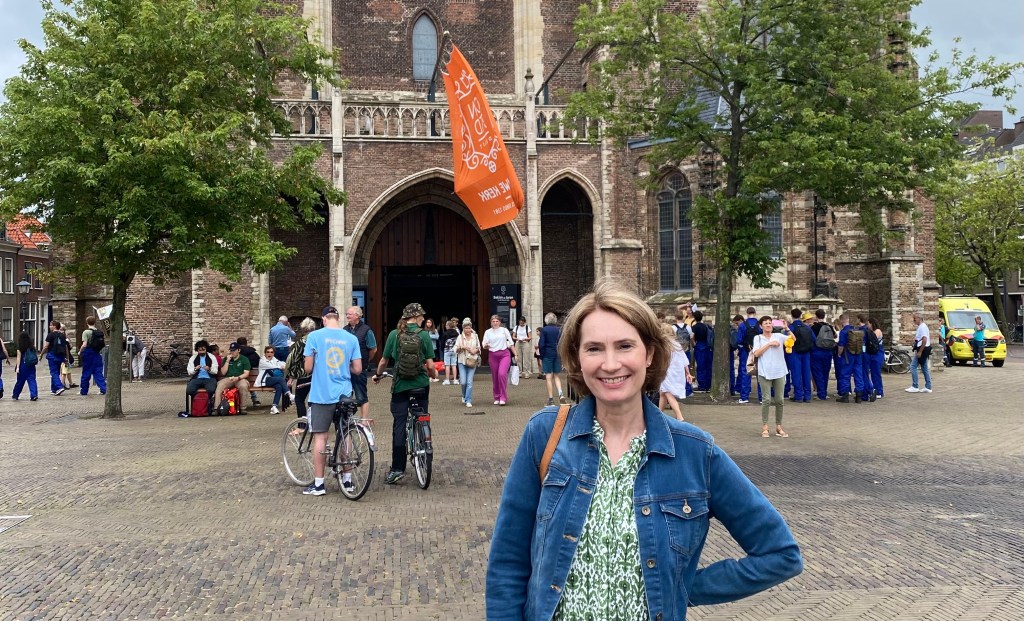
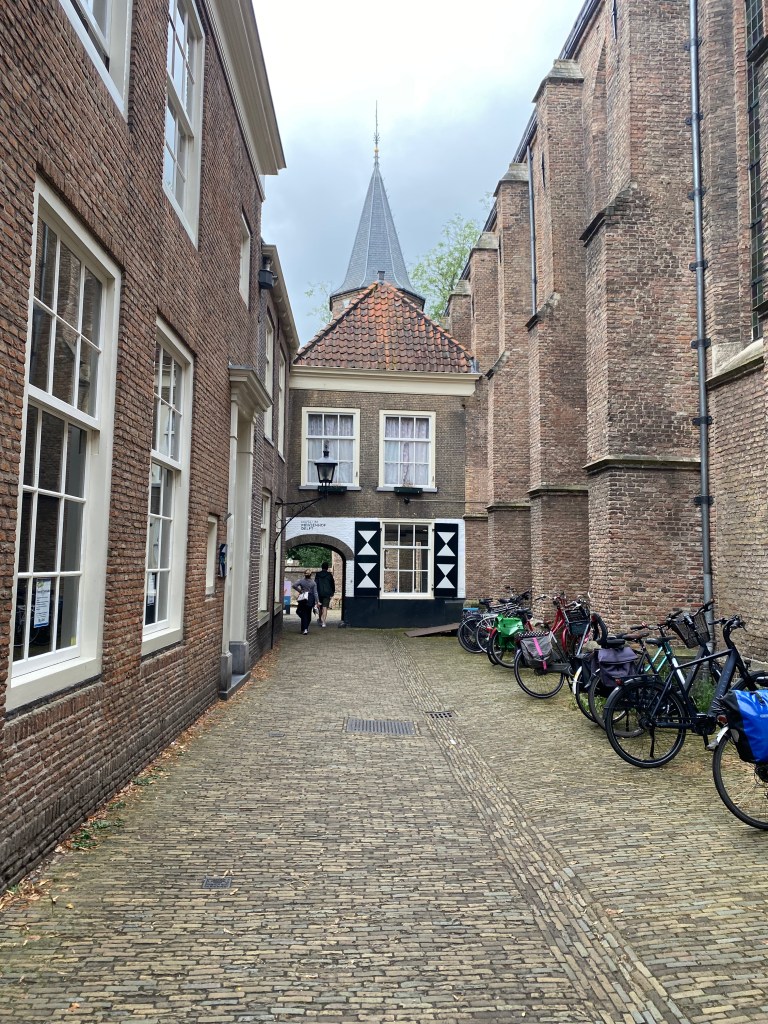
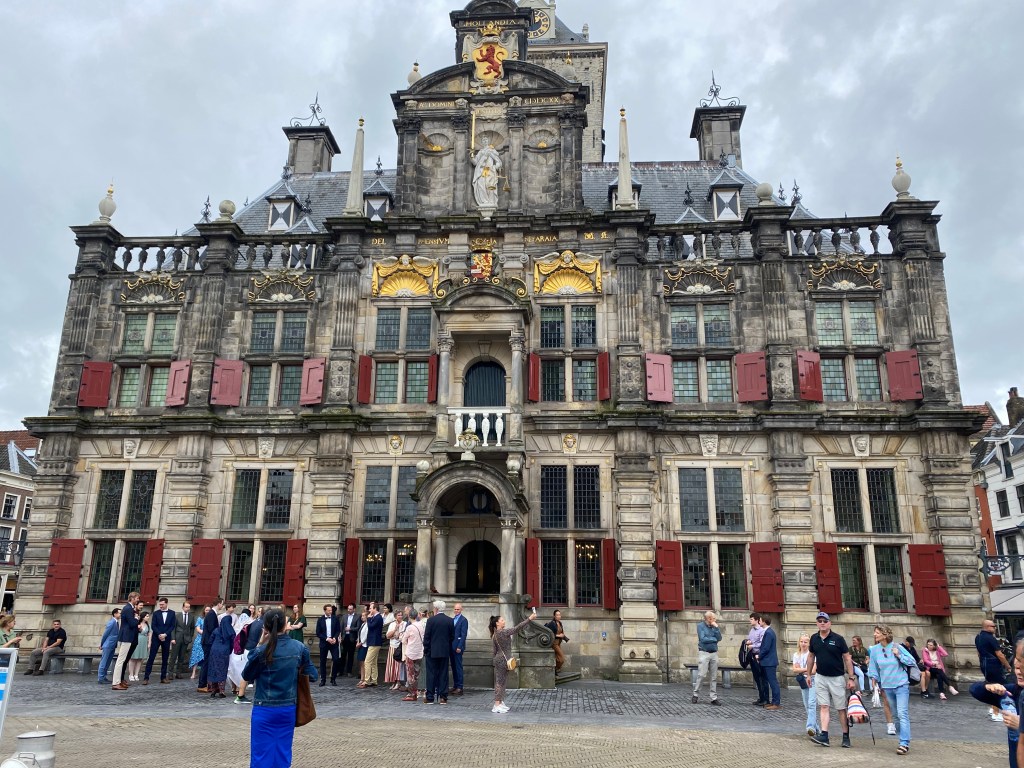
Delft is well known among Brits for its beautiful blue-and-white pottery, with its intricate Delftware designs. But this charming city has far more to offer than ceramics alone. It’s a wonderful place to explore on foot in a day — a bit like Amsterdam in miniature, with canals and bridges weaving through the historic city centre.
We were lucky enough to join a walking tour with @freewalkingtourdelft, which gave us a great potted (no pun intended!) history of the city. Combined with having a Dutch-history-teacher husband on hand, it meant I learned a lot.
Here are five fascinating historical reasons to visit Delft.
Hugo de Groot
In Delft’s large market square you’ll find a statue of Hugo de Groot (Hugo Grotius). Often referred to as the first international lawyer, he laid the foundations of international law and is one of the reasons the Netherlands is now home to the International Court of Justice.
Vermeer
Another famous figure from Delft is Johannes Vermeer. He grew up here, and many of his paintings depict scenes inspired by the city and its surroundings. I was lucky enough to visit the Rijksmuseum last year for the Vermeer exhibition — the largest collection of his work ever shown in one place. Seeing his paintings and then walking through Delft itself, with so many historic buildings still intact, makes it easy to imagine life in the 17th century.
William the Silent
Delft also played a key role in the life — and death — of William the Silent, also known as William of Orange (not to be confused with the later Williams of Orange). He ran his military operations from Delft, and it was here that he was assassinated. The bullet holes are still visible in the wall of his former residence, now the Museum Prinsenhof.
The story of his assassin, Balthasar, is a dramatic one. After firing the fatal shot, he attempted to escape by jumping into the moat surrounding the city walls, using an inflated pig’s bladder to stay afloat. Unfortunately for him, he couldn’t swim and was quickly captured by city guards, after which he was brutally executed.
Resting place of Dutch monarchs
Traditionally, members of the House of Nassau were buried in Breda. However, when William the Silent died, Breda was under Spanish control, so he was buried instead in the New Church in Delft. Since then, most members of the House of Orange-Nassau — including all Dutch monarchs — have been laid to rest there.
Interestingly, his great-grandson William III, who was King of England, Scotland, and Ireland as well as Stadtholder of the Netherlands, was buried in Westminster Abbey.
Delft pottery
Finally, to the pottery — but with a bit more context.
In the Middle Ages, Delft was home to both a textile industry and a thriving brewing tradition. Textile dyeing polluted the water, while clean water was essential for brewing — and beer was economically vital (and safer to drink than water at the time). Delft chose beer, and textile production gradually shifted to cities such as Leiden.
Later, the Dutch East India Company imported expensive blue-and-white porcelain from China, creating huge demand across Europe. When political unrest in China disrupted supplies, Dutch potters seized the opportunity. They made everyday pottery appear luxurious by painting a white glaze with blue decoration on top. The industry flourished for around a century, from 1640 to 1740, exporting tiles, plates, vases, and figurines across Europe — and securing Delft’s place in history.



 Rachel's Round-up
Leave a comment